This à la carte learning provider uses woodwork to instill deeper lessons
JACKSONVILLE, Fla. — Alex Knott began to gravitate toward woodworking in 2021, first as he was remodeling he and his wife’s fixer-upper, then as he was teaching his friend’s kids how to build birdhouses. His interest led him to the classic PBS show, “The Woodwright’s Shop.” He watched, rapt, when the series re-aired a segment about “sloyd,” an approach to education through woodworking that originated in Scandinavia in the late 1800s.
A year later, The Sloyd School was up and running.
Alex’s wife, Lindsey, tapped their homeschool connections for an initial cohort of 21 students. That turned out to be more than enough for Alex, then a gainfully employed mechanical engineer, to realize he wanted to do this full time.
“The kids didn’t use a lot of words, but you could see it in the smiles on their faces. They’d say, ‘This is so cool’ and ‘This is so satisfying,’ “Alex said. “And their parents would say, ‘It’s nice that they’re using their hands to make things, and they’re off the screens.’ “
Demand, too, signaled the Knotts were on to something. Today they serve 91 students across 13, 90-minute classes. The students range from 8 to 20 years old.
Alex’s full-time job now is being their instructor.
They’re “not doing it because they’re necessarily going to be a woodworker someday,” Alex said. “They’re doing it because they want to learn, and they want to make stuff, and they just love planing and sawing and the way they’re bodies move.”
“If they take satisfaction and pride in their work,” he continued, “that’s going to carry forward.”
The Sloyd School is another bloom on the most diverse and dynamic education landscape in America.
In Florida, where school choice and education choice are the new normal, it’s easy to find former public school teachers behind new schools and à la carte providers. But it’s also not hard to find other talented people creating compelling options, like this marine biologist … this neuroscientist … this building contractor …
Alex worked as a design and process engineer. Lindsey taught literature in a hybrid homeschool. Now their fledgling operation is one of roughly 8,000 à la carte providers that, in just a few short years, are already part of Florida’s choice-driven education system. With 150,000+ à la carte learners and more than $1 billion in à la carte spending this year, Florida is setting the pace nationally when it comes to unbundling education.
Classes at the Sloyd School are aimed at cultivating “skilled hands and wise hearts.”
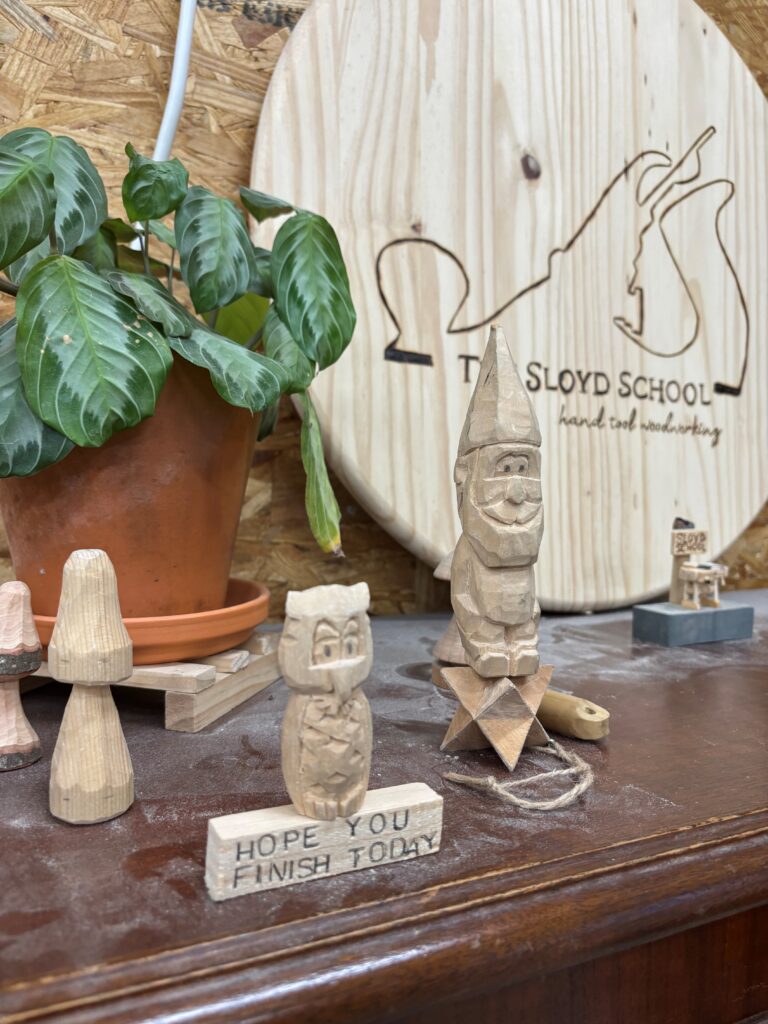
The magic happens in a spacious workshop next to the Knotts’ home. It’s sweet with the smell of sawdust and alive with the bang and scrape of wood being transformed.
Most of the students use either the Personalized Education Program scholarship or the Family Empowerment Scholarship for Students with Unique Abilities. Both are education savings accounts that can be used for parent-directed learning.
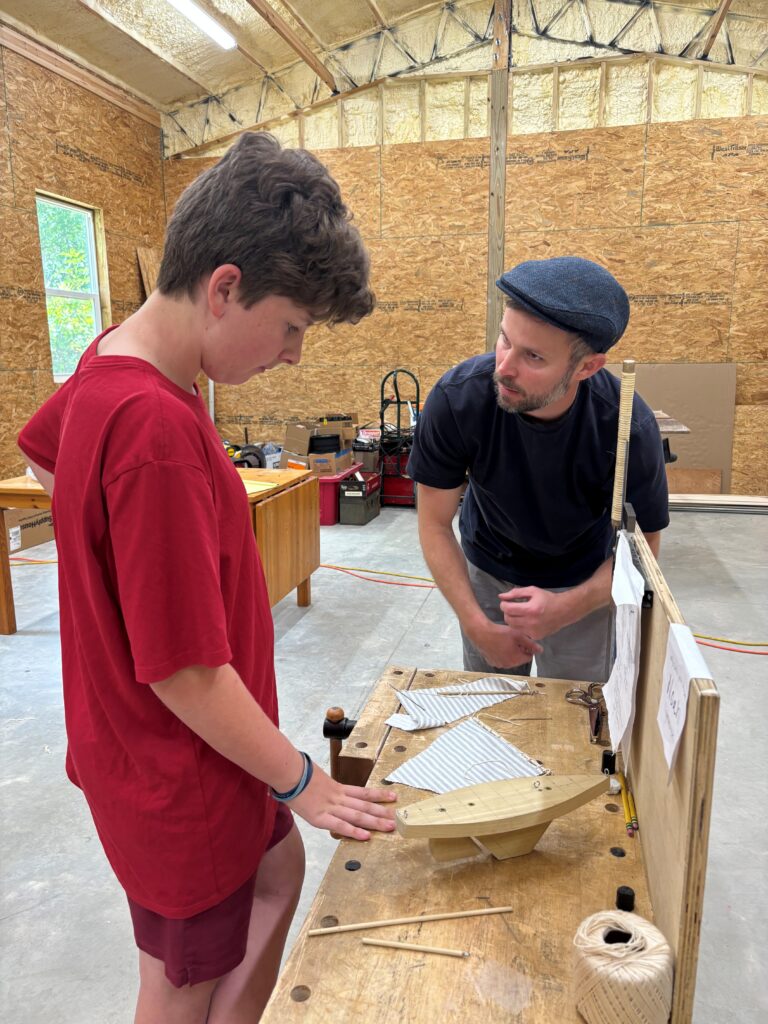
The students fashion their projects at individual work benches, arranged in two rows against a backdrop of walls made from oriented strand board and wood scraps stacked neatly on shelves. With planes and files and a variety of other hand tools, they make everything from yo-yos and hat racks to toy sailboats and crossbows.
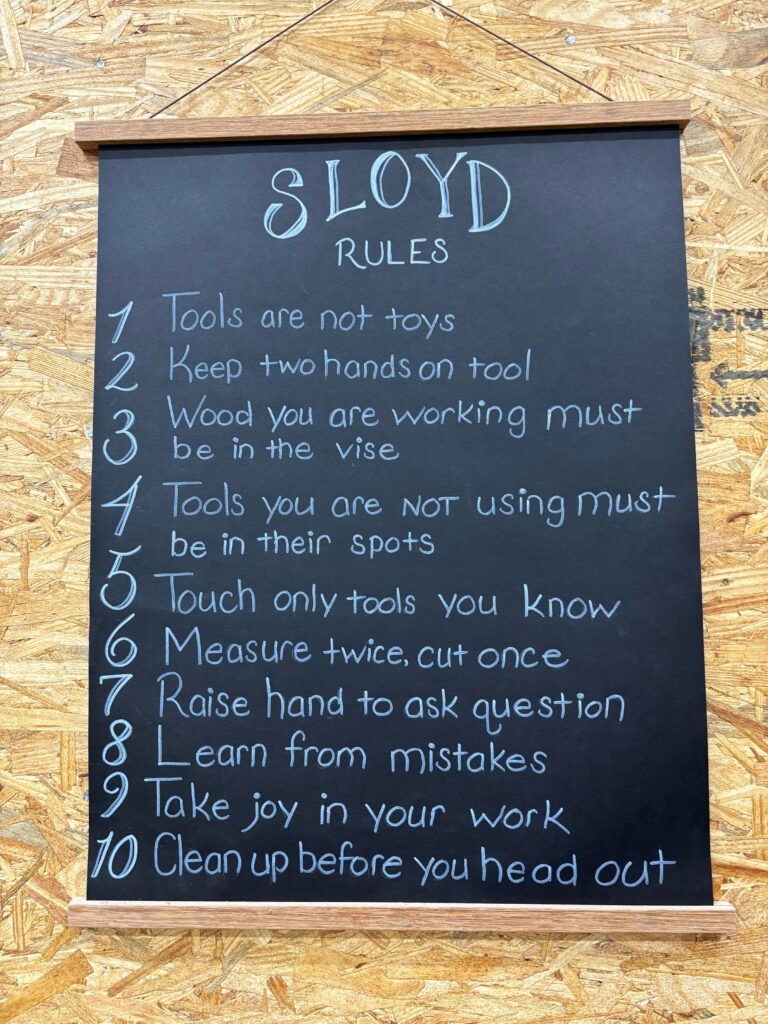
Power tools are not in the mix. The school website explains why, in terms that should be savored:
“Because hand tools function as an extension of the hand, rather than reducing the hand to a manipulator of buttons or mechanical arm, they immerse us in the full benefits of handwork; they bring the world close enough to experience its spectacular range of textures and scents and hues, to feel the difference between working with rather than against its grains and currents and patterns, to move from knowing about the world as a fact to knowing it as a friend.”
Alex scaffolds his lessons, starting with the simplest exercises, then adding new skills class by class. The students follow written instructions for their projects. But Alex offers guidance as he makes the rounds with a newsboy cap on his head and a pencil perched on his ear.
“This side looks really, really tight,” he told a student making a stool, referring to where a leg fit into the socket on the underside of the seat. “But this side’s got a little gap.”
Another student was making a helicopter-on-a-stick toy that’s propelled by spinning the stick between the palms and abruptly stopping. “I’ve found that if you make these a little thinner,” Alex said of the blades, “it’ll fly better.”
Both students listened and nodded, then got back to work.
Sloyd is about way more than the practical skill of making things with wood.
The lessons are deeper: Pride in work. Problem solving. Persistence …
Laura Flaherty enrolled her oldest son Matthew after hearing about the class in 2023. Her father, a civil engineer whose hobby was woodworking, unexpectedly died five years ago just as he had begun to teach Matthew the basics.
“We were all happy to have someone with as much skill and knowledge as Alex teach our boys,” said Laura, a former veterinarian who’s now a stay-at-home mom of four. “He’s a calming presence too. He’s so good with how he explains things.”
Matthew, now 12, likes the challenge. His favorite projects are the toughest ones, like the windmill he finally finished after breaking several blades.
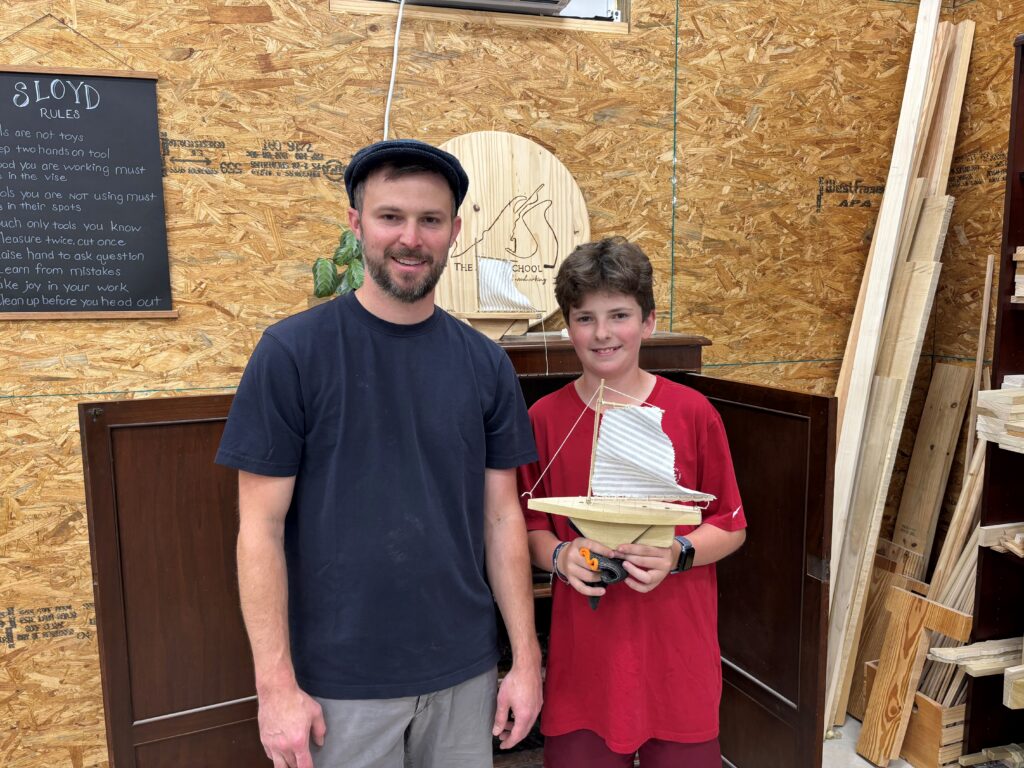
“There were several projects he told me were frustrating, but he kept at it,” Laura said. “If you make mistakes, you keep moving and eventually you’ll get it.”
The Sloyd School feels like a bridge, not only between past and present, but between different educational camps. It evokes other threads in alternative education, like the “common arts” idea that surfaces in some classical education circles, and the “handwork” from Waldorf education.
The school website nails the deeper connections.
“To shove a plane across a pine board is to work in the pattern of countless others across time and place, and to join hands with them in sustaining and shaping a facet of human culture,” it says. A few sentences later it adds, “Yet over above all this, we delight to work with wood because it is a living material, individual, intriguing, and lovely.”
Piece by piece, The Sloyd School and other à la carte providers are re-shaping public education into something more individual, intriguing, and lovely, too.